
Why Access Alone Doesn’t Solve Menstrual Health Challenges
In many conversations around menstrual health, access is treated as the answer. If girls have sanitary pads, the problem is solved.
But on the ground, it rarely works that way.
Pads may reach a school or a community, yet girls still hesitate to use them. Some continue using cloth. Others avoid changing them regularly. In some cases, the pads are available but remain unused.
Access changes availability. It does not automatically change behavior.
When Access Doesn’t Translate into Use
Providing sanitary products is important, but usage depends on comfort, understanding, and habit.
In many rural settings, girls grow up watching older women use cloth. That becomes the normal. Even when pads are introduced, switching is not immediate. There can be hesitation around:
- how to use them correctly
- how often to change them
- where to dispose of them
- whether it is acceptable to use them at all
A study published in BMC Women’s Health highlights that menstrual practices are shaped by education, family habits, and social norms, not just the availability of products.
Without addressing these factors, access remains underused.
The Role of Comfort and Privacy
Even when a girl has a pad, she still needs a place to use it comfortably.
If school toilets are not functional, lack water, or feel unsafe, managing menstruation becomes difficult. In such situations, girls may avoid using pads during school hours or choose to stay home altogether.
Global findings from WHO and UNICEF show that gaps in sanitation facilities directly affect menstrual hygiene practices in schools.
This is where access meets infrastructure and often breaks down.
Information Shapes Decisions
Knowing that pads exist is different from knowing how to use them properly.
Many girls receive products without clear guidance. Questions remain:
- How long can one pad be used?
- What is considered safe hygiene?
- What should be avoided?
Without this clarity, practices vary widely.
UNESCO notes that menstrual education plays a key role in helping girls adopt safe and consistent hygiene habits.
Information does not need to be complex. It just needs to be timely and clear.
Social Norms Still Influence Behavior
In some communities, menstruation is still associated with restrictions – not entering kitchens, avoiding social spaces, or staying separate.
These beliefs affect how girls view their own periods. Even with access to products, hesitation remains if the environment around them does not support open conversation.
Changing behaviour takes time because it involves unlearning what has been normal for years.
What Actually Makes Access Work
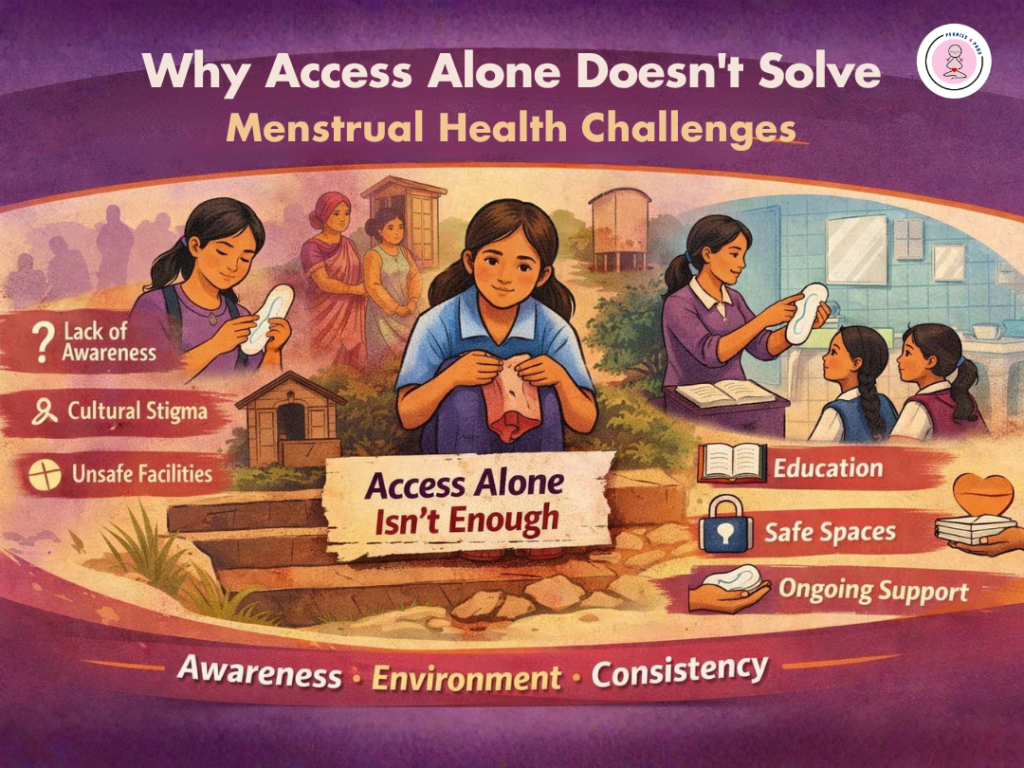
Access becomes effective when it is supported by:
- basic awareness
- safe spaces to manage periods
- consistent availability, not one-time distribution
- an environment where girls can ask questions without discomfort
These elements work together. Removing one weakens the rest.
Where Pennies 4 Pads Fits In
Pennies 4 Pads works through schools to make menstrual support more consistent and accessible. By providing sanitary pads regularly and introducing basic awareness, the initiative helps reduce hesitation and uncertainty around usage.
When support is steady and familiar, girls are more likely to adopt safer practices over time.
A More Complete Approach
Menstrual health challenges are rarely caused by a single gap. They are shaped by access, awareness, environment, and social norms working together.
Focusing only on one piece can limit the outcome.
A more complete approach looks at how girls actually experience their daily lives — in school, at home, and within their communities.
That is where real change begins.
From Access to Real Impact
Making menstrual products available is an important step. Making them usable, accepted, and part of everyday life is what creates lasting impact.
Pennies 4 Pads focuses on this continuity, ensuring that access is supported with regular presence and familiarity within schools.
Because when access is combined with understanding and consistency, it becomes something girls can rely on, not just something that is available.