
How Water, Sanitation, and Menstrual Health Are Connected in Rural India
Access to sanitary pads is often seen as the starting point of menstrual health support.
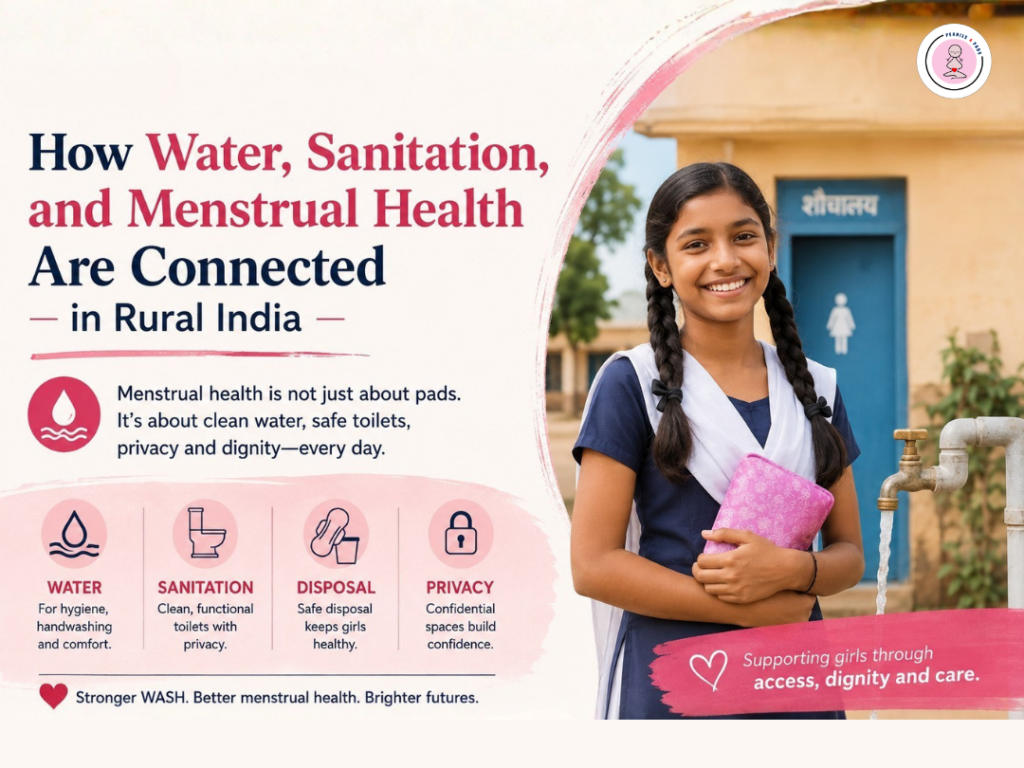
But managing a period requires much more than a product.
A girl may have a sanitary pad and still struggle to use it properly if she does not have access to clean water, a functional toilet, or a safe place to change.
This is where menstrual health becomes closely linked to sanitation.
Managing Periods Needs More Than Products
A sanitary pad can only do part of the job.
Girls also need:
- water to wash their hands and maintain hygiene
- toilets that offer privacy
- spaces where they can change comfortably
- systems for safe disposal
Without these basics, even access to pads becomes difficult to sustain.
A girl may avoid changing her pad during school hours if the toilet is unusable. Another may stay home because she has nowhere private to manage her period.
The challenge is not always the absence of products. Sometimes, it is the absence of the environment needed to use them properly.
The School Infrastructure Gap
For many adolescent girls in rural India, school is where menstrual management becomes most difficult.
Toilets may be unavailable, poorly maintained, or lack water access. Disposal bins are often missing.
A joint report by World Health Organization and United Nations Children’s Fund found major gaps in menstrual hygiene facilities in schools globally, including access to private toilets, bins, and water.
When these facilities are missing, periods become harder to manage during the school day.
Why Water Matters More Than We Think
Menstrual hygiene is directly linked to handwashing, cleaning, and personal comfort.
Without reliable water access:
- girls may not wash hands after changing pads
- reusable materials may not be cleaned properly
- overall hygiene practices become harder to maintain
A research study published through National Center for Biotechnology Information notes that inadequate WASH (Water, Sanitation and Hygiene) facilities increase menstrual health challenges and limit safe hygiene practices.
Water is rarely discussed in conversations about periods, but it quietly influences everything.
Privacy Affects Confidence
Infrastructure is not only about functionality. It is also about dignity.
A toilet without a lock, broken doors, or open spaces can create discomfort and anxiety for girls managing menstruation.
This often leads to delayed changing, reduced water intake, or avoiding school altogether during heavier days.
Privacy is one of the most basic requirements for menstrual hygiene, yet it is still inconsistent across many rural settings.
Menstrual Health Is Part of WASH
Menstrual health and WASH are deeply connected.
Global organisations increasingly recognise that periods cannot be addressed in isolation from sanitation systems.
UNICEF places menstrual hygiene management within its broader WASH framework, recognising that access, hygiene, and dignity depend on functioning systems working together.
This broader view helps shift the conversation from products alone to everyday conditions.
Where Pennies 4 Pads Contributes
Pennies 4 Pads works within schools to make menstrual management more practical and accessible.
Regular sanitary pad distribution helps girls avoid immediate product gaps, while school-based support creates a more familiar and manageable environment for handling periods.
When access is built into everyday school life, girls are better equipped to navigate their periods with less disruption.
Looking at the Full Picture
Menstrual health is often reduced to one visible need – sanitary pads.
But behind every pad is a larger system: water, toilets, privacy, and disposal.
Without these essentials, managing menstruation remains difficult, even when products are available.
Improving menstrual health means looking beyond what girls use, and paying attention to the spaces where they use it.
Creating Better Conditions for Menstrual Health
Supporting menstrual health means making everyday environments more manageable for girls.
Pennies 4 Pads contributes to this by ensuring regular access to sanitary pads through schools, helping girls feel more prepared and supported during menstruation.
Because real menstrual support depends not only on what girls receive, but also on the conditions in which they live, learn, and grow.